
HONGWUMACHINERY Request a QuoteGet a quote ↗
Application study / Aluminum food packaging

Coat the tray stock.
Prepare the foil lid.

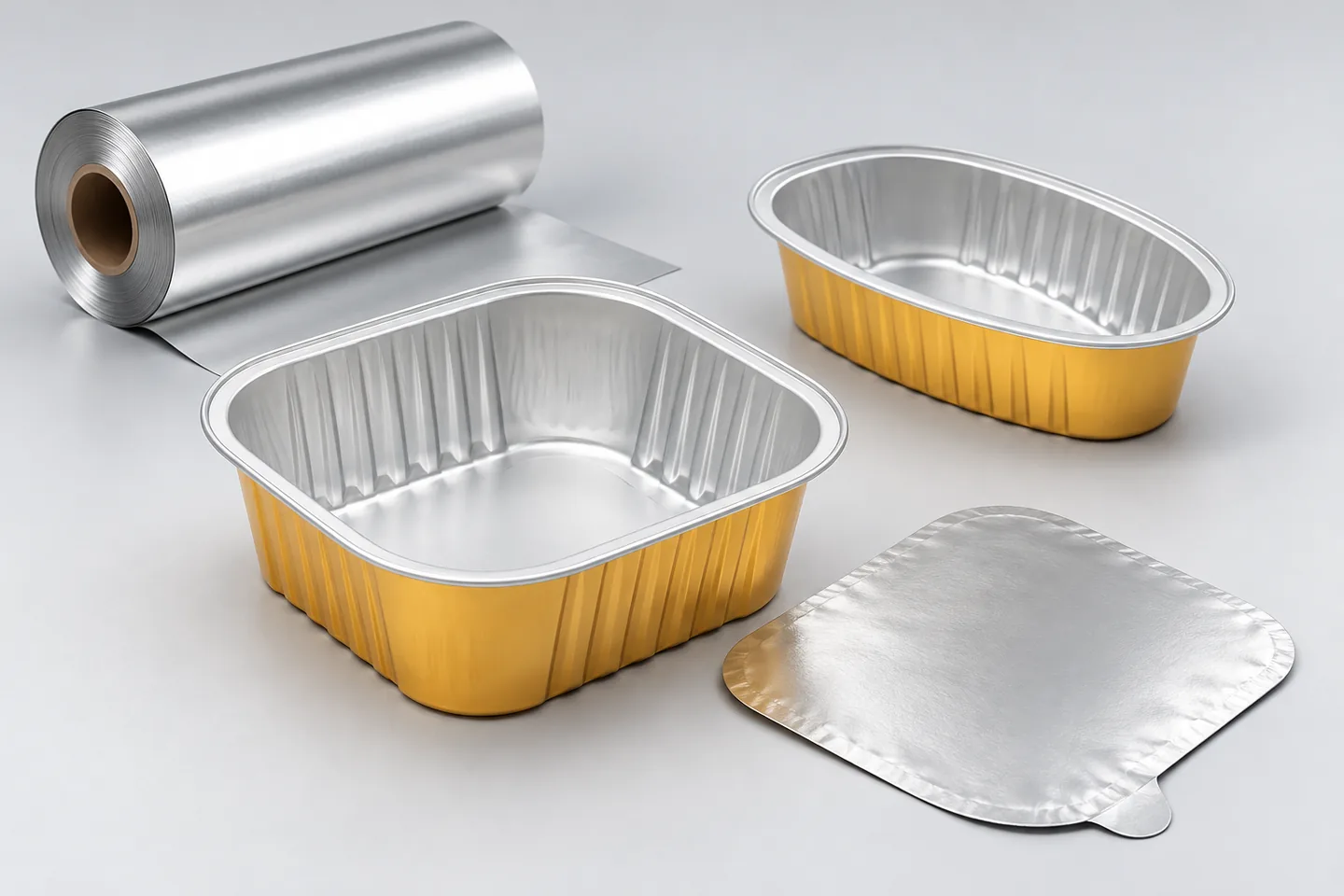
Gold on the outside. Protective lacquer on the inside. A matching heat-seal coating on the aluminum lid.

Double-sided tray coatingAluminum lidding foil
Explore the two structures
Gold-coated aluminum trays with silver interiors, a loose aluminum foil lid and a foil roll
Packaging illustration. The appearance shows the application, not a customer production sample.
Tray web
Gold / AL / protective lacquer
Lid web
Aluminum + heat-seal coating
Process focus
Meter · dry · cool · rewind
Downstream
Customer forming & sealing
01 / Material roles

Two webs.
Different coating jobs.

The tray stock and the foil lid are coated materials with different functions. Select each layer to see what it contributes to the application.

01 / Two coated faces

The food tray stock.

Outside / gold finishInside / food-facing surface

Select a layer to explore its role.

Appearance & adhesion

Control the finish at the coating stage.

The gold color is applied to the aluminum web before the customer forms the tray. The coating discussion starts with an even finish across the working width.

Coating review

Review metering, color and gloss, coating weight and adhesion. Keep application and drying records for the selected lacquer.

The tray-forming stock

Start with the actual foil specification.

Foil gauge, alloy, temper and surface condition define the incoming material. These specifications belong to the tray stock and are recorded separately from the thinner lidding material.

Coating review

Confirm incoming surface condition and transport tension. The customer handles downstream tray forming.

Coverage & integrity

Give the inside face its own coating controls.

The silver-looking inside has a protective lacquer. Its grade, coverage and curing requirements must be specified for the intended food and use conditions.

Coating review

Review coating weight, coverage and adhesion. The protective lacquer is not automatically a heat-seal layer.

02 / A matching seal face

The aluminum foil lid.

Outside / print or protection, if requiredSeal face / toward the actual tray rim

Select a layer to explore its role.

Optional print / protection

Define the outside treatment.

As with aluminum yogurt lids, the outside may carry print and a protective coating. The exact arrangement follows the lidding product specification.

Coating review

Confirm whether print, primer or protective lacquer is needed, and which operations are on the coating line.

Separate foil specification

Prepare the foil that becomes the lid.

This application uses aluminum lidding foil, following the coating concept of a yogurt foil lid. Foil thickness and temper are specified for this product, rather than copied from the tray stock.

Coating review

Review web condition, handling and rewind stability. Do not borrow the yogurt-lid gauge without confirming this lid specification.

Matched to the tray rim

Match the coating to the sealing surface.

The heat-seal layer faces the tray rim. Selection follows the actual rim surface and its coating, along with the required sealing and opening behavior.

Coating review

Review coating weight and uniformity, adhesion and blocking. Verify sealing with the actual tray and lid samples.

Layer diagrams are functional illustrations, not thickness drawings. Tray and lid gauges, coating weights and coating grades follow the actual material specifications.

02 / From web to coated roll

The coating line
is the heart of the case.

Follow the five coating stages. Gold lacquer, inner protection and the lid seal layer have separate application and drying requirements.

01 / Unwind

Prepare a stable web.

Check the tray foil and lidding foil separately: surface condition, width, gauge and winding quality. Set transport tension for each web rather than treating them as interchangeable.

What to record: Record the incoming foil specification and look for defects before coating.

02 / Meter the coating

Control what reaches each surface.

The tray web receives gold exterior coating and inner protective lacquer; the lid receives its heat-seal coating, with outside treatment if required. Each coating needs its own application weight and metering setup.

What to record: Review wet versus dry coating weight, solids, viscosity measurement conditions, roll condition and transverse uniformity.

03 / Hot-air drying

Give each coating its required heat history.

Hot air dries the coated web. Carrier removal and any required curing follow the specific coating system. Air temperature, foil temperature and residence time are separate records; the coating dryer setting is not the downstream sealing temperature.

What to record: Confirm oven zones, airflow and exhaust, the required foil temperature history and its relationship to line speed.

04 / Cool & inspect

Check the coated web before rewinding.

Review gold color and gloss, inner-lacquer coverage and lidding-coating uniformity. Check adhesion and the cooled web condition, with residual testing appropriate to the chosen coating system.

What to record: Sample left, center and right across the web. Record cooling conditions and web or roll temperature.

05 / Rewind

Deliver the coated material as a controlled roll.

Set rewind conditions for the coated stock and confirm separation after storage. The customer then forms the tray and converts the lid before filling and sealing.

What to record: Review blocking, winding quality and batch traceability. Forming and production sealing remain downstream customer operations.

Drying principle / Hot air Hot-air drying of a coated web Heated air enters a distribution plenum, reaches the coated web through nozzles, and exits through controlled exhaust. This is a principle schematic, not a machine layout. Air distribution plenum Heated air supply Coated web direction → Exhaust Airflow + foil temperature + residence time
Principle schematic. Actual zones, ducting and protective controls follow the coating system.
Coating sequence: unwind, meter, hot-air dry, cool and inspect, rewind Unwind Meter the coating Hot-air drying Cool & inspect Rewind Coated roll → customer forming / lid converting → filling & sealing

Process sequence shown as a functional overview. Coating pass order and one-pass versus separate-pass operation depend on the machine configuration and coating system.

03 / Coating priorities

Measure the coating.
Control the heat history.

Use web samples and process records to connect metering, drying and roll quality. Review each coating system separately.

01

Metering & uniformity

Check dry coating weight and its distribution across the width. Review solids, viscosity measurement conditions and metering-roll condition when investigating stripes or uneven color.

Left · Center · Right
02

Drying & curing

Record oven-air settings, actual foil temperature history and residence time. Surface dryness alone does not establish adequate cure for a coating that requires crosslinking.

Explore drying engineering →
03

Cooling & rewinding

Review cooled-web condition, winding quality and separation after storage. Assess residuals and odor with suitable tests rather than appearance alone.

Adhesion · Residuals · Blocking
Coating symptoms / What to investigate
Gold color varies, or stripes appear across the web

Compare left, center and right samples. Check incoming surface condition, coating-weight distribution, lacquer condition and the metering setup; compare these with drying records before assigning a cause.

The inner protective lacquer has gaps or poor adhesion

Review surface preparation, wetting, coating coverage and adhesion. Confirm any primer requirement and the coating supplier’s cure conditions. Customer-formed samples can provide supplementary feedback.

Coated material blocks or develops odor after storage

Review drying and residual testing, cooling and roll temperature, coating blocking resistance and rewind conditions. Compare retained samples after storage; touch and smell alone do not establish acceptability.

The lid seals unevenly, leaks or opens inconsistently

Check heat-seal coating uniformity and anchorage, then its compatibility with the actual tray-rim surface. Keep sealing temperature, dwell time and pressure records. Separate coating issues from rim contamination or sealing-equipment issues.

04 / The matching interface

The lid meets the rim.
The coatings must match.

The lidding concept resembles an aluminum yogurt lid. Here, the sealing partner is the coated rim of an aluminum food tray.

Aluminum lid and coated tray-rim interface The aluminum lid carries a heat-seal layer above the actual coated tray-rim surface. The two are brought together during downstream heat sealing. The separated layers are not to scale. Aluminum lid Heat-seal layer Actual rim coating Tray foil Interface schematic · layers not to scale
The rim coating must be identified. Its heat-seal compatibility is established with the selected lid coating.

Protection and sealing are separate specifications.

The tray’s inner protective lacquer is already part of the stock. Whether it can act as the sealing partner must be confirmed; adding a separate tray seal layer is not assumed.

01
Identify the interface

Actual rim surface + selected lid heat-seal grade.

02
Define the sealing window

Temperature, dwell time and pressure on actual tray-and-lid samples.

03
Review the finished seal

Leakage and seal continuity, plus peel behavior where easy opening is required.

Coating prepares the materials. Production forming, filling and heat sealing are downstream customer operations.

05 / Application review

Start with the materials.
Build a recorded trial.

Bring the tray-stock and lid specifications together before defining equipment and settings. Each web needs its own process record.

Review item Tray stock Aluminum foil lid
Material Foil gauge, alloy, temper and surface Lidding gauge, temper and surface treatment
Coating system Gold exterior + inner protective lacquer Heat-seal grade + outside treatment if required
Metering Separate coating weight and roll setup for each face Heat-seal coating weight and transverse coverage
Drying & winding Coating-specific heat history, cooling and winding conditions Coating-specific drying, residuals and blocking review
Sample checks Color / gloss, coverage and adhesion Adhesion and actual tray-and-lid seal tests

This study describes the supplied packaging concept and coating review approach. Numerical settings and measured production results are not specified here.

Discuss your food-packaging coating

One packaging application.
Two coating discussions.

Share your tray foil, inner and outer lacquer, aluminum lid and heat-seal coating specifications.

Application structure supplied by Hongwu. Background references: Symetal coated container foil · ACTEGA heat-seal coatings · EAFA container sealability.